
Monks embody peace, wisdom, and strength, making their names deeply symbolic and meaningful.
Whether you’re crafting a character, naming a child, or simply exploring spiritual inspiration, this guide presents 415 monk names categorized by theme.
Let this list inspire your journey to serenity and enlightenment.
What Makes a Name Read as a Monk Name
The word carries the whole design rule inside it. Etymonline traces monk back through Old English munuc and Late Latin monachus to ecclesiastical Greek monakhos, meaning solitary, from monos, meaning alone. A monk name is a name that has had things taken away from it. Every other fantasy class adds material to sound impressive. This one subtracts, and the subtraction is what reads as discipline.
Length is therefore the first and strictest rule, and it runs opposite to almost everything else in naming. One syllable is ideal here, which is true nowhere else: Ren, Kai, Jun, Tao, Sho, Mun, Bo, Chen. Two works when both halves are plain: Anzan, Kenji, Miro, Dorje, Sonam, Padma. Three is already pushing it and usually signals a formal ordination name rather than the name anyone actually says. Anything longer stops sounding like a monk and starts sounding like a wizard who took a vow. If you find yourself with four syllables, cut back to the first two and you will almost always improve it.
The vocabulary comes from four wells, and they are more distinct from one another than in any other style, so mixing them carelessly is the fastest way to sound wrong. The first is Sino-Japanese Zen, which gives you Ren, Kaito, Anzan, Genjo, Shuko, Daishin, Roshi. The second is Tibetan and Sanskrit, which gives you Dorje, Tenzin, Sonam, Lobsang, Ananda, Padma, Bodhi, Sangha. The third is Christian monastic, which is Latin and Greek and reads entirely differently: Benedict, Anselm, Aidan, Cuthbert, Brother Sylvan, Columba. The fourth is the plain English virtue and nature stock, which is the most portable of the four and the one most people underuse: Still, Ash, Clay, Reed, Wren, Vale, Hollow. A name from any one of these lands cleanly. A name that puts Tenzin next to Cuthbert lands nowhere, because it is claiming two traditions that never met.
Sound follows the same logic as length. Monk names avoid consonant clusters almost entirely. Compare Ren, Kai and Jun to Brynjar, Skarde and Grimr and the difference is immediate: the monk names are open, the warrior names are armored. Long vowels and single consonants carry the style, which is why Tao, Mira, Anu and Sho all feel settled while Krast and Thrand feel braced. Nasals do a particular amount of work here, since m and n are the two sounds you can hold indefinitely on one breath, which is exactly what chanting is. Om, Mun, Anzan and Nen all lean on that. Sibilants add stillness rather than menace when they are unaccompanied, so Sen, Shu and Silas sit comfortably where Vex and Sable would not.
Three structures cover the whole field. The bare given name is the default and it is stronger here than anywhere else, because a monk with a single name is signalling that everything else has been renounced: Ren, Dorje, Anselm. The second is the title plus name, which is how monastic communities actually address each other, giving you Brother Anselm, Master Sho, Elder Wen and Sister Miro. This shape does an enormous amount of work in two words, since the title tells you the institution exists and the name tells you the person inside it does not need decoration. The third is the descriptive dharma name, a name given at ordination that describes a quality rather than a person: Clear Water, Still Mountain, Empty Bell, One Reed. These read as translations, and that is the point, since they are meant to sound like something rendered out of another language rather than chosen off a shelf.
What tips a monk name into try-hard is ornament, and the failure mode is specific: adding power words. Shadowfist Zen Master Ryuu Bloodpalm fails because every element is fighting the one thing the class is about. Merriam-Webster defines ascetic as practicing strict self denial as a form of spiritual discipline, and a name stuffed with adjectives is the opposite of self denial. The second failure is stacking honorifics, so Grandmaster Elder Sifu Ren says three times what Master Ren says once. The third is mixing scripts and apostrophes to look exotic, which reads as costume rather than practice. A monk called Ren is more intimidating than a monk called Ryu’zen Deathpalm, because the short name implies there is nothing left to strip away.
Zen-Inspired Monk Names
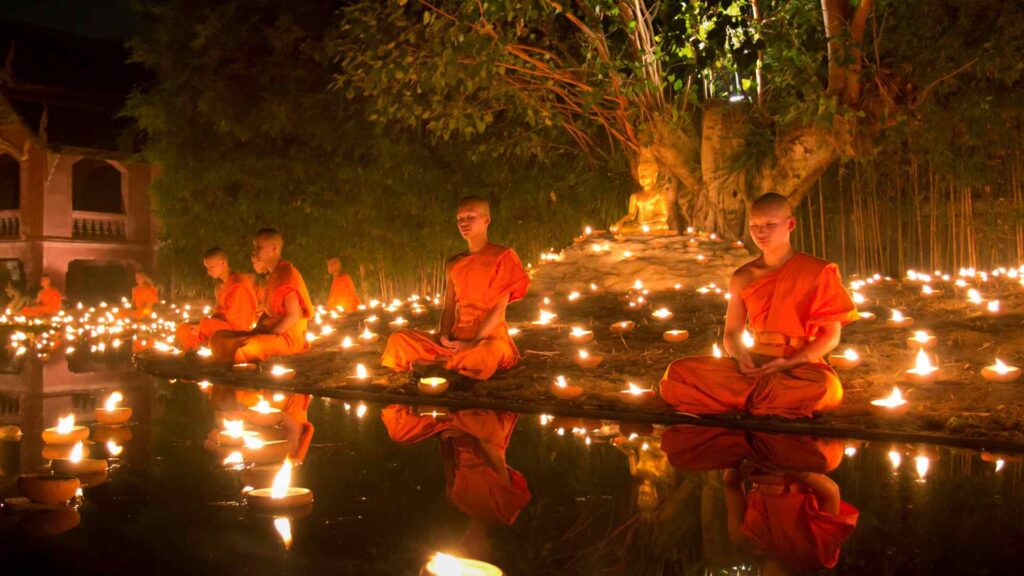
These names draw inspiration from Zen traditions, evoking tranquility and mindfulness.
- Aiko
- Akira
- Botan
- Chiyo
- Daiki
- Eito
- Genzo
- Haku
- Haru
- Hiro
- Ichiro
- Isamu
- Jin
- Kaito
- Kaname
- Kazuo
- Kiyoshi
- Makoto
- Masaru
- Michi
- Nobu
- Rei
- Riku
- Ryo
- Sachiko
- Satoru
- Shiro
- Sora
- Taichi
- Takashi
- Taro
- Tomoko
- Toshio
- Yasu
- Yori
- Yoshio
- Yuki
- Zenji
- Akemi
- Ayaka
- Fumiko
- Hoshiko
- Kaori
- Keiko
- Kimiko
- Misaki
- Naomi
- Noriko
- Sachiko
- Yumiko
Spiritual Monk Names
Names inspired by spiritual qualities like peace, enlightenment, and virtue.
- Amara
- Anand
- Arjuna
- Ashoka
- Bodhi
- Chaitanya
- Dev
- Dharma
- Gyan
- Indra
- Ishaan
- Jai
- Jivan
- Kailash
- Kalpa
- Karma
- Mahesh
- Mantra
- Moksha
- Namaste
- Nanda
- Niranjan
- Nirvana
- Omkar
- Parama
- Pranav
- Rajesh
- Sachi
- Samadhi
- Samara
- Sanat
- Satya
- Shakti
- Shiva
- Siddhartha
- Sita
- Sudama
- Sundar
- Surya
- Tara
- Tejas
- Upala
- Usha
- Veda
- Vidya
- Vishal
- Yogi
- Yuga
- Zendo
Mythical and Legendary Monk Names
Names inspired by legendary monks or mythical traditions.
- Avalokiteśvara
- Ananda
- Bodhidharma
- Hui Neng
- Ikkyu
- Kukai
- Laozi
- Nagarjuna
- Padmasambhava
- Sanzang
- Shantideva
- Xuanzang
- Yasodhara
- Zhuang Zhou
- Aśvaghoṣa
- Bhante
- Chandaka
- Dhammapala
- Jivaka
- Kashyapa
- Kondanna
- Maudgalyayana
- Nanda
- Prajna
- Rahula
- Shariputra
- Subhuti
- Upali
- Vasubandhu
- Vajrapani
- Vimalakirti
- Yasa
- Zhiyi
- Sengcan
- Dogen
- Milarepa
- Linji
- Ryokan
- Nagarjuna
- Hakuin
- Saicho
- Eisai
- Rinzai
- Dongshan
- Yongjia
- Wumen
- Ikkyu
- Zhaozhou
- Taizan
Nature-Inspired Monk Names
Names tied to elements of nature, symbolizing harmony with the environment.
- Ash
- Bamboo
- Blossom
- Brook
- Cedar
- Cliff
- Cloud
- Dawn
- Drift
- Echo
- Fern
- Flame
- Forest
- Frost
- Haven
- Lake
- Leaf
- Meadow
- Mist
- Moon
- Mountain
- Ocean
- Petal
- Pine
- Rain
- River
- Rock
- Rose
- Sand
- Shade
- Sky
- Snow
- Spring
- Star
- Stone
- Stream
- Sun
- Tempest
- Thunder
- Tide
- Valley
- Water
- Wave
- Whisper
- Wind
- Winter
- Wood
- Zen

Warrior Monk Names
Warrior monk names reflecting strength, courage, and discipline.
- Aran
- Athelstan
- Bjorn
- Cadmus
- Daedalus
- Einar
- Faramir
- Galen
- Gunnar
- Hagen
- Horace
- Ivan
- Jorah
- Kael
- Lancelot
- Marcus
- Orion
- Percival
- Ragnar
- Roan
- Ronin
- Sable
- Stellan
- Tiberius
- Tristan
- Uther
- Valor
- Vaughn
- Verity
- Wren
- Wolfe
- Xander
- Xerxes
- Yorick
- Zane
- Zephyr
- Zeus
- Abelard
- Baldwin
- Calan
- Dareon
- Edris
- Fenris
- Gethin
- Haldor
- Ingvar
- Jarl
Extra Monk Names
Here’s a bonus section of names for additional inspiration.
- Aiden
- Alaric
- Amrita
- Asher
- Basil
- Baran
- Caspian
- Chanda
- Darius
- Dorian
- Elias
- Emrys
- Ezra
- Flynn
- Gideon
- Hiram
- Idris
- Isidore
- Jasper
- Jorah
- Khalid
- Lachlan
- Malachai
- Nolan
- Octavian
- Phineas
- Quentin
- Rafael
- Silas
- Taliesin
- Tobias
- Tybalt
- Ulysses
- Vesper
- Xanthus
- Zared
- Zechariah
- Zephyrine
- Zion
- Aarav
- Abner
- Adriel
- Callum
- Eamon
- Everest
- Finnegan
More Monk Names
- Aarush
- Abhay
- Acharya
- Adarsh
- Akshara
- Amar
- Amrit
- Aria
- Aryan
- Asanga
- Ashin
- Atman
- Ayana
- Bhadra
- Bhakti
- Chandana
- Charaka
- Daksha
- Darshan
- Dayananda
- Devraj
- Dhira
- Divya
- Ekam
- Eshan
- Gauri
- Gautama
- Govinda
- Hansa
- Harita
- Indira
- Ishita
- Jagannath
- Jagrav
- Jaya
- Jyoti
- Kanchan
- Kiran
- Krishna
- Lila
- Lokesh
- Madhava
- Mahima
- Maitreya
- Malini
- Mani
- Manisha
- Megha
- Mitra
- Mohan
- Mukti
- Nalanda
- Namrata
- Nayana
- Neelam
- Nila
- Nivedita
- Pankaj
- Param
- Parvati
- Pavitra
- Prasad
- Priya
- Punya
- Radha
- Raja
- Rajni
- Raksha
- Ramana
- Ranjan
- Rati
- Ravi
- Riddhi
- Rohan
- Rohini
- Ruchi
- Sadhu
- Samrat
- Sandeep
- Sangha
- Sarada
- Sarvesh
- Savita
- Shaila
- Shankar
- Sharanya
- Sharv
- Shuddha
- Siddhi
- Soma
- Tara
- Tejal
- Udaya
- Usha
- Vanya
- Ved
- Vidur
- Vimal
- Vinay
- Vishnu
- Yajna
- Yash
Fitting the Name to Your Monk
Nothing here is taken the way a username is taken, so the real work is matching the name to the character. Three questions decide it, and they should be answered in this order.
First, which tradition raised this character. Pick one and stay inside it, because a monastery is a culture and cultures do not blend at random. A Zen inflected order gives you Ren, Anzan, Shuko and Genjo. A Himalayan order gives you Dorje, Tenzin, Lobsang and Sonam. A western contemplative order gives you Anselm, Aidan, Benedict and Columba. An invented order in your own setting still needs internal consistency, which means picking a phonetic rule and holding to it. If every monk in your order has a one syllable name ending in a vowel, then the ninth one does too, and that consistency will do more worldbuilding than any amount of description.
Second, how the character fights, because monk is the one contemplative class that is also a martial class. Britannica dates the founding of the Shaolin Temple in Henan province to 495, and credits Bodhidharma with introducing martial arts as a complement to meditation, a practice that grew into Shaolin kung fu. That is the useful precedent: the fighting came out of the sitting, not the other way around. So the name should sound like the discipline rather than the violence. A character who fights open handed and defensively suits the softest end of the range: Miro, Anu, Wen. A character built around a single decisive strike suits a name with one hard stop in it: Kai, Tak, Jun, Brand. If the build has drifted so far toward combat that the contemplative half is gone, you are no longer naming a monk, and the vocabulary behind warrior names will serve you better.
Third, where the character is in their own history, because monks are the one archetype with a built in name change. Most monastic traditions give a new name at ordination, which hands you a free storytelling device. Give the character a plain birth name and a taken name, then decide which one the party gets to use. A monk who introduces himself as Ren but is called Tobias by one specific person has an entire backstory implied in two words, and you never had to write it down. The same device covers rank. A novice keeps the birth name. An elder has been the taken name so long that nobody remembers the other one.
Then say it out loud twice at normal speed. If the table has to ask how it is spelled, it will become a nickname by the second session and you will lose control of it. A one syllable name never fails this test, which is one more argument for the short end of the range.
Where to Look Next
If the discipline is right but the flavor is not, a few neighboring lists are worth opening. For a character whose power comes from the natural world rather than from training, druid names draw on plant, animal and season vocabulary that sits close to monastic plainness without the monastery. For a scholar who studies rather than practices, wizard names run longer and older, with Latin and Welsh bones. And for a character who keeps the stillness but turns it toward killing, assassin names use the same restraint for a very different purpose. All of them, plus the races and creatures, are laid out on the fantasy character names page.
Conclusion
Monk names carry a sense of serenity, wisdom, and power. Use this list as a guide to find the perfect name for your monk-inspired journey. With these 415 names, you’re sure to discover the ideal match.